
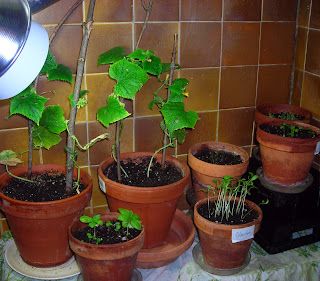
When planning my BathroomFarm, I often worried that light would be insufficient for growing vegetables indoors. There is precious little information on this subject and the information is often presented in terms so different it's hard to determine how anything applies to this situation. I know I added 7,000 lumens to the ambient sunlight in the room. I'm not sure how that compares to research with results measured in foot-candles or how that applies to the "plant in full sun" on the seed packet.
Apparently, things are growing. That's a good thing. However, I have noticed that as the plants grew toward the light, some leaves would appear to burn. It has been a little bit of a challenge to keep the plants distanced from the light which is intense. I have also looked into companion planting to solve part of the problem. Companion planting is interesting because it can solve a variety of problems just by placing plants in proximity to each other. Because container gardens can be crowded, I'm going to take advantage of many physical and chemical advantages companion plants give each other.

My ceiling baskets were a disaster. I wanted to grow leafy greens in them and nothing was
working. The spinach and Swiss chard seeds died as soon as they sprouted. It turned out they were getting too much light for too long even though both seed packets said "full sun". I browsed random Internet gardening forums for guidance. It turns out that greens aren't that keen on sun worship. My solution is to not keep the light on for as many hours, to lower the baskets away from the light and plant green beans as a companion for shade. After less than two weeks, the results are showing. The spinach has sprouted and started to grow!
The amount of time the light is on may also be
inhibiting the flowering and fruiting of the plants.
 My Minnesota Midget Melons have been vining LIKE NUTS but not much more. I read about the forcing of flowers and learned that long periods of simulated sunlight might inhibit flowering so I cut back on the hours and have the room completely dark at night. I had been leaving standard
fluorescent bulbs in the wall fixures on at night, but I stopped that. Voila! In less than a week, the melons have started blooming!
I'm glad I was a little bit conservative in the quantity of plants I started for the initial BathroomFarm because it has been challenging to determine what this system needs as it develops. The plants on the wall are doing well. I have a 5' long tomato vine growing in a gallon milk jug. The changes in light should also benefit its fruiting. I will probably not use milk jugs for future plantings although they do work. I do like the gallon beverage bottles with plants growing up and down.

I have collected canopies from umbrellas that had bad experiences in Indiana thunderstorms for making wall pockets. I feel that I can confidently add more crops at this time. I'm making wall pockets to fill in the space on the wall and using more containers on the floor and on top of the slipcovered
shelves I use for my garden shed. I also decided there is absolutely no reason to start seeds separately from planting them directly somewhere in my garden. Of course, I decided that after starting more seeds! So, when I transplant the seedlings now on the window ledge, I'm going to use that space for growing collards in pots and vining zucchini around this extremely sunny window!
Temperature has also been an issue in this room. I may have kept it a little too cool during the day and a little too warm at night. I'm going to try to maintain 80 degrees during the day and 65 degrees at night and see how that works. The window ledge where the collards will grow IS a little cooler than the rest of the room, but they should be fine in cooler conditions. I'm not so sure the zucchini will like that so I also started some plants in pots on the side of the room with the vertical garden which is warmer and will let them vine on to the wall.
I am always willing to fail forward on projects with uncertain outcomes and the BathroomFarm is no exception. Now that the light and temperature issues have been resolved and results are showing, I can move forward more quickly now. Winter may be an optimum season in the BathroomFarm. There were some insect issues throughout the summer that are over now. *Something* ate an entire basil plant in just one night! There were other casualties, too, but nothing so stunning. I am optimistic that the most difficult parts are over and the fantasy of plucking midget melons from the vine while soaking in a hot, bubbly tub in the dead of winter will be a reality!




 The first step was the hardest and the most hazardous. I set a 2 x 4 vertically in a bucket of Quikrete to make the base of the lamp. You HAVE to protect your eyes, mouth and nose, and hands when you use this material. I watched videos on the company website to learn how to use it first. I made the lamp inside of my Bathroom. I scooped the mix out of the bag to avoid dust and because I couldn't pick up the 80-pound bag! Going slowly, I mixed a small amount in the big bucket and put the board in. I used the edge of my desk to make sure it was straight. Then, in a small bucket I mixed little batches and filled the big bucket the


 at Home Depot was very cool about it as was the store itself allowing me to bring merchandise I owned inside!


 plant stand in the back hallway of the house to sprout. This was my only option since the room where the BathroomFarm would be was undergoing renovations because of serious water damage from a house fire several years ago. We had a rather cool and dreary spring. The seedlings did sprout but developed poorly because of lack of sunlight to warm the lead surface. By the time the weather took a turn for the better, the giant ginko tree outside the south windows, shaded the plant stand.


 While my seedlings are sprouting to life, I am taking the opportunity to explore the great out of doors in Historic Woodruff Place as viewed through the watchful eyes of our wildlife friends! The actual real estate developed into Woodruff Place was once a dense forest appropriately named The Dark Woods. There are still remnant ancient trees in the neighborhood. I am proud to say that my neighbors are avid planters of new trees, too. Our canopy is so lush in places, there is no need to use an umbrella in light rain. I feel like I am living in a forest paradise!


 This is the view from the bedroom, too. Imagine waking up in a city with a view of wilderness! This area is left alone to evolve itself over time. For many years, I lived
 in a tree house!


 interior of a place left undisturbed by humans for two decades.


 st step away from planning the vertical vegetable and herb garden in my bathroom and into the actual execution of the project. I truly believe that it is 100% possible to empower yourself by growing your own food and also believe that good results are attainable by anyone regardless of economic situation or skill level. After all, I am starting from nowhere with nothing and no clue! I do have, however, the willingness to learn and am fearless to fail forward until I make this work.I spent part of the winter reading about gardening and studying seed catalogs and websites. I decided the best way to proceed IS to make Bathroom Farming accessible to ALL.
 urban areas where financial stress is increasing. Therefore, I decided to make the first version of my Bathroom Farm using grocery store seeds and materials commonly found around the house and neighborhood. I love all of the designer seeds available on the market through specialty garden shops. However, the seeds from the grocery store, as well as bedding plants, are produce department food items and are eligible items to be purchased with food stamps. I purchased the potting soil from my neighborhood dollar store within walking distance of my home. Everything else was upcycled, salvaged and repurposed from my very awesome personal collection of quality junk. Bathroom Farming affirms the idea of a food democracy.

 In addition to the melons and peppers, I am also growing oregano, chives, cherry tomatoes, slicing tomatoes, sweet basil, cilantro, parsley,Swiss chard, spinach, carrots, lettuce,cucumbers and green beans!


 Looking above the ramp, you'll notice a pair of windows neither in line with the first floor windows nor the second floor windows. This is the location of the plant stand on the back stairway.
 d at their bottoms to allow air to circulate which prevents legginess in plants. The surface of the plant stand is a slab of
 lead. The lead prevents moisture from seeping into undesired places in the building and retains heat from the sunlight flooding in through the large windows during the day.